
Every software project, system upgrade, or new IT tool a company adopts starts the same way: someone on the business side wants a problem solved, and someone on the technical side has to build the actual solution.
An IT business analyst is the person standing between those two groups, making sure the thing that gets built is actually the thing the business needed in the first place.
This guide covers exactly what the role involves, how it differs from a general business analyst, what it pays, which certifications matter, and how to build a career in it — all sourced directly from official data rather than guesswork.
Here’s what we’ll cover:
- What an IT business analyst actually does
- IT business analyst vs. business analyst: the real difference
- Core responsibilities and a typical day
- Skills and tools the role requires
- IT business analyst salary, sourced from BLS data
- Certifications that matter (ECBA, CCBA, CBAP)
- Career path, from entry-level to senior roles
- Frequently asked questions
What Is an IT Business Analyst?
An IT business analyst — sometimes called a business systems analyst — is responsible for analyzing an organization’s information technology systems and recommending how they can better serve business needs. According to Indeed’s employer-facing job description guidance, IT business analysts refine the roles and responsibilities of IT teams, create implementation requirements, and develop IT plans in collaboration with both business and technical stakeholders.
Put simply: this role translates business problems into technical requirements, and translates technical constraints back into terms the business side can act on. Coursera’s career overview describes IT business analysts as “strategic problem-solvers” focused specifically on understanding, analyzing, and recommending IT systems — including evaluating new software and planning its implementation.
The role sits at the intersection of two departments that don’t always speak the same language. A business stakeholder might say “our order process is too slow.” An IT business analyst’s job is to turn that vague complaint into a specific, documented, testable set of requirements that a development team can actually build against.
IT Business Analyst vs. Business Analyst: What’s the Real Difference?
This is one of the most confusing distinctions in the field, partly because job titles aren’t standardized across companies. Based on how the role is consistently described across multiple sources, here’s the practical difference.
A general business analyst may work on process improvement, financial analysis, market research, or operational efficiency — with or without any direct connection to a technology system. Their output might be a new workflow, a policy change, or a business case, none of which necessarily touches software.
An IT business analyst specifically focuses on technology systems and software. Their work is anchored in IT projects: evaluating system gaps, defining software requirements, supporting implementation, and working directly alongside developers, systems architects, and IT project managers throughout a project’s lifecycle.
In practice, many companies use “business analyst” and “IT business analyst” interchangeably, especially at smaller organizations where one person covers both functions. At larger enterprises, the distinction tends to be clearer, with dedicated IT business analysts embedded specifically within technology or digital transformation teams.
Core Responsibilities of an IT Business Analyst
Responsibilities vary by employer and industry, but a consistent core set of duties shows up across job descriptions and industry guidance:
- Eliciting and documenting requirements — gathering functional and non-functional requirements directly from stakeholders through interviews, workshops, and observation
- Conducting gap analysis — comparing current IT systems against desired business outcomes to identify what’s missing
- Translating business language into technical specifications — a skill that industry guides describe as central to preventing “expensive rework” caused by miscommunication between business and technical teams
- Facilitating communication between stakeholders and technical teams — often serving as the primary point of contact between business leadership and developers
- Supporting solution design, testing, and delivery validation — staying involved through implementation, not just the planning phase
- Managing change, risk, and stakeholder expectations as a project evolves
- Drafting statistical and analytical reports that help decision-makers choose between competing options or vendors
Modern IT business analysts increasingly work inside Agile and hybrid delivery environments rather than traditional waterfall projects, according to recent industry analysis — meaning the role now involves continuous, iterative collaboration with delivery teams rather than a single upfront requirements phase followed by silence until launch.
Skills and Tools IT Business Analysts Actually Use
The skill set splits into three broad categories, and strong IT business analysts typically need real ability in all three, not just one.
Analytical and technical skills:
- Data analysis and interpretation
- Requirements gathering and documentation methods
- Familiarity with tools like Microsoft Excel and Power BI for reporting and visualization
- Working knowledge of SQL and databases (increasingly expected, though depth varies by employer)
- Understanding of systems architecture, sufficient to have informed conversations with developers
Process and methodology knowledge:
- Familiarity with the BABOK Guide (Business Analysis Body of Knowledge), the IIBA’s standard reference framework
- Comfort working within Agile, Scrum, or hybrid delivery methodologies
- Project and requirements management tools, commonly including platforms like Jira and Confluence
Communication and soft skills:
- Stakeholder management across both technical and non-technical audiences
- Facilitation skills for requirements workshops and interviews
- Clear written documentation — a genuinely underrated skill, since ambiguous requirements documents are a leading cause of project rework
- Critical thinking and problem-solving under ambiguity, since business problems rarely arrive already well-defined
How Much Does an IT Business Analyst Earn?
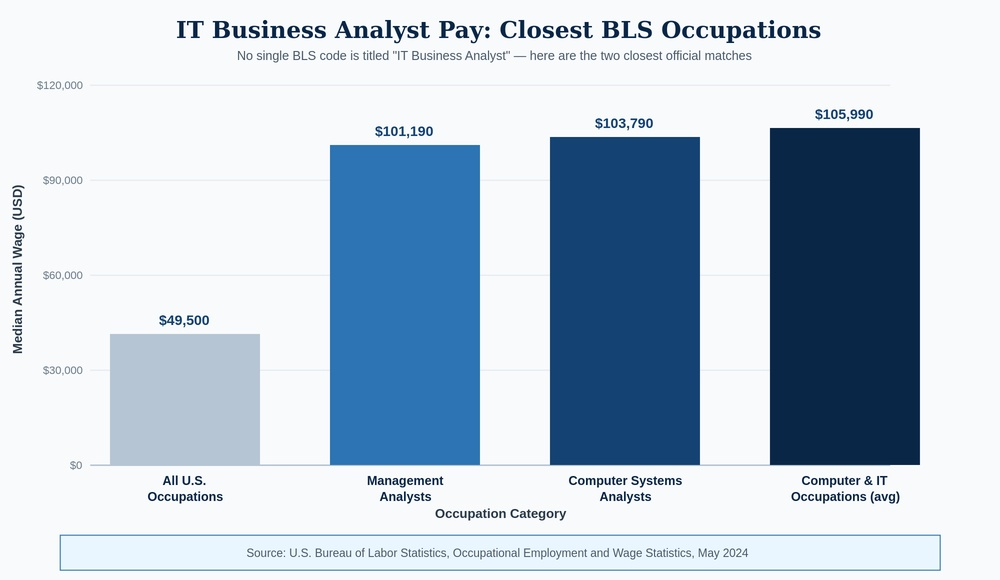
This is where we need to be precise rather than convenient: there is no single official occupation code titled “IT Business Analyst.” The U.S. Bureau of Labor Statistics doesn’t track this exact job title, because employers use it inconsistently. Instead, the role maps most closely to two distinct BLS-tracked occupations, and the honest answer draws on both.
Computer Systems Analysts (BLS classification 15-1211) — the closer technical match for IT-focused business analyst work — had a median annual wage of $103,790 as of May 2024, according to the BLS Occupational Outlook Handbook. Employment in this category is projected to grow 9% from 2024 to 2034, much faster than the 3% average across all U.S. occupations, with about 34,200 openings projected annually.
Management Analysts — the closer match for business-process-focused analyst work — had a median annual wage of $101,190 as of May 2024, per the same BLS source.
For context, the broader “Computer and Information Technology” occupational group carried a median annual wage of $105,990 in May 2024, compared to a median of just $49,500 across all U.S. occupations — underscoring how strongly the technology sector pays relative to the general labor market.
Because actual IT business analyst compensation depends heavily on employer, industry, seniority, and location, treat these BLS figures as a well-sourced directional range — roughly $100,000 to $105,000 at the median — rather than a single precise number for this specific job title.
Certifications That Matter: ECBA, CCBA, and CBAP
The International Institute of Business Analysis (IIBA) is the leading professional body for business analysis credentials, and it offers three official certification levels.
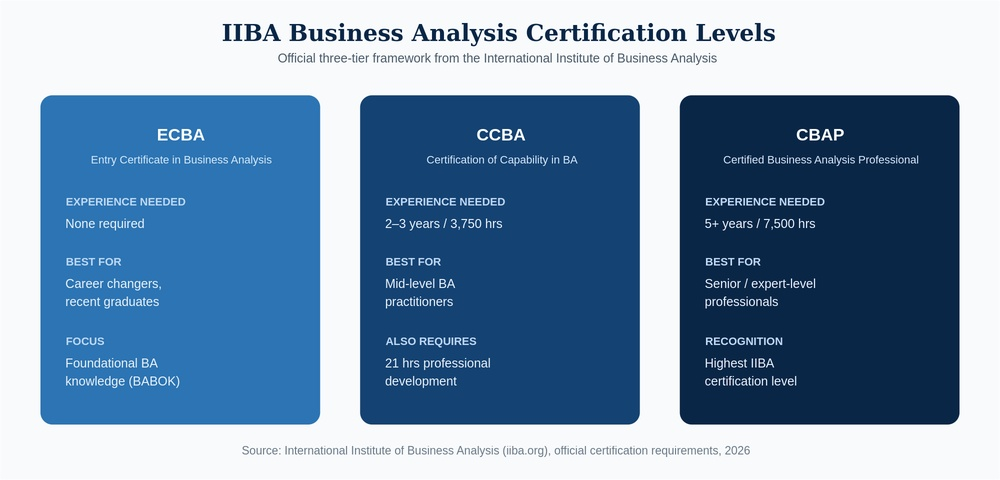
ECBA (Entry Certificate in Business Analysis) has no formal work experience requirement, making it accessible to career changers and recent graduates who want to formalize foundational business analysis knowledge before landing their first role.
CCBA (Certification of Capability in Business Analysis) requires 2 to 3 years of business analysis experience, with a minimum of 3,750 hours of documented work history within the last seven years, plus at least 21 hours of professional development within the last four years, according to IIBA’s official certification FAQ.
CBAP (Certified Business Analysis Professional) is the highest level IIBA offers, requiring more than 5 years of business analysis experience and a minimum of 7,500 hours of business analysis work history, positioning it for senior and expert-level practitioners.
Beyond IIBA’s core three, Agile-specific credentials (such as Scrum.org’s PSM1 or PSPO1) are increasingly requested alongside or instead of IIBA certifications in job postings, particularly at organizations running Agile delivery teams — worth researching directly against the specific employers or industries you’re targeting.
Career Path: From Entry-Level to Senior IT Business Analyst
A typical path into this field starts with a bachelor’s degree in computer science, information technology, or business administration, though career changers from adjacent fields (finance, operations, project coordination) also enter successfully with relevant experience.
Entry-level roles often carry titles like Junior Business Analyst or IT Business Analyst I, where new analysts gain hands-on experience with requirements documents, project scopes, and stakeholder meetings under closer supervision.
With experience, analysts typically progress toward Senior IT Business Analyst or IT Business Analyst III/IV designations, taking on larger, more ambiguous projects and greater ownership of stakeholder relationships.
From there, career paths tend to branch in a few directions: analytics or BA team management, enterprise architecture, IT consulting, or a pivot toward adjacent roles like product management or project management, depending on individual interest and the skills emphasized along the way.
Volunteering for cross-functional projects, even informally, is commonly cited across industry career guides as one of the most effective ways to build the specific experience (requirements documentation, stakeholder facilitation, scope definition) that hiring managers and certification bodies alike look for.
Frequently Asked Questions
What does an IT business analyst do on a daily basis? Daily work typically includes stakeholder meetings, requirements documentation, reviewing system data or gaps, collaborating with developers or IT teams on solution design, and updating project documentation as requirements evolve.
Is an IT business analyst a good career in 2026? Based on BLS projections, the closest tracked occupations (computer systems analysts, management analysts) show above-average growth and median wages well above the national average, suggesting solid long-term demand — though, as with any tech-adjacent role, specific outlook varies by industry and region.
Do I need to know how to code to become an IT business analyst? Not typically as a strict requirement, though working knowledge of SQL and general technical fluency is increasingly expected, particularly for roles embedded deeply within technical delivery teams.
What’s the difference between an IT business analyst and a systems analyst? The roles overlap significantly and job titles vary by employer. Generally, systems analysts focus more narrowly on technical system design and architecture, while IT business analysts maintain a stronger emphasis on translating business requirements into those technical specifications.
Which certification should I get first: ECBA, CCBA, or CBAP? ECBA is the appropriate starting point for those with little or no formal business analysis experience; CCBA and CBAP require documented work history (3,750 and 7,500 hours respectively) that most newcomers won’t yet have.
Final Thoughts
An IT business analyst’s core value isn’t technical wizardry or business savvy alone — it’s the ability to hold both perspectives at once and prevent the expensive miscommunication that derails IT projects. With strong BLS-backed demand, a clear certification pathway through IIBA, and genuine flexibility to specialize toward either the technical or business-facing side of the role over time, it remains a well-documented, defensible career choice heading into 2026.
If you’re building toward this role and want to strengthen your foundational business analysis skills first, our guide to the best business analyst course for beginners is a solid next step.
References
- U.S. Bureau of Labor Statistics — Computer Systems Analysts Occupational Outlook
- U.S. Bureau of Labor Statistics — Computer and Information Technology Occupations Overview
- Indeed — IT Business Analyst Job Description
- Coursera — IT Business Analyst: Duties, Salary, and How to Become One
- IIBA — Certification FAQ
- IIBA — Global Standard for Business Analysis Certifications